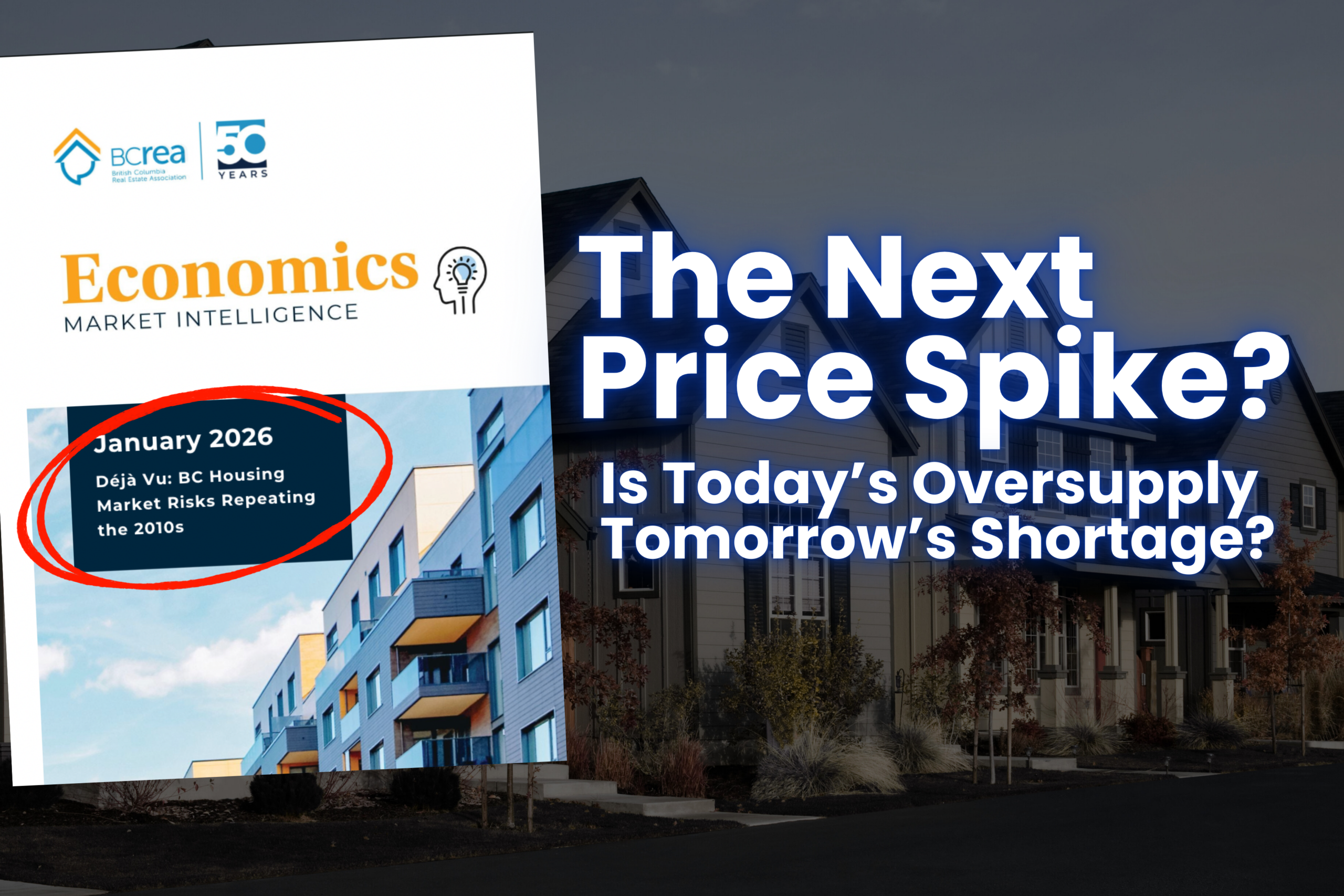
If you look at BCREA’s Housing Monitor, one chart should get you asking some questions: the one showing homes under construction vs. completions across British Columbia.

If you pull back to 10-20+ years ago, you’ll see how the number of units under construction remained on par with completions, with the expected lag. This makes sense since we would expect the number of homes under construction to lead to a similar number of homes to complete. “Under construction” would rise as projects started; a year or two later, completions would follow, and the gap between them stayed relatively stable.
In 2016 that relationship broke. In 2022 it completely divorced.
Over the 2024-2025 period, we experienced the record number of homes under construction while, at the same time, having the largest gap in modern BC history between units being built and units being completed. Completions are rising—meaning a lot of product is coming—but “under construction” had climbed so far, so fast, that the spread is historically unprecedented.
This is what I’m calling BC’s construction gap, and it’s one of the most important structural stories in the housing market over the next couple of years.
What Is the “Construction Gap” and Why Does It Matter?
When we talk about the construction gap, we’re talking about the difference between:
- the number of homes currently under construction; and
- the number of homes actually completing each year.
In a healthy, steady-state market, you expect a roughly proportional relationship: when builders ramp up activity, under-construction numbers rise; after a lag, completions move up as those projects finish. The lines aren’t identical, but they tend to be parallel, and the gap between them doesn’t blow out.
That is more or less what we saw in BC up to about 2015–2016. The market had cycles, but the “machine” itself worked: homes started, homes completed, and the pipeline didn’t get wildly out of sync.
Since then, something has changed.
Explaining “Under Construction” and Why It Matters
When interpreting this chart, it’s important to understand exactly what BCREA and CMHC mean when they classify a unit as “under construction.” According to the technical definition, a home enters the “under construction” category once physical building has begun—typically when the foundation and footings are poured—and it stays in that category until the unit is fully completed and ready for occupancy. In other words, “under construction” is not an abstract planning number: these are real projects, actively being built, with labour, materials, financing, and municipal inspections already engaged. The category does not include rezonings, OCP-aligned units, approved development permits, or theoretical pipeline estimates. It reflects only those homes where construction has genuinely started, even if the project later slows, stalls, or extends its timeline.
This definition is central to understanding the construction gap. Because “under construction” captures all units that have passed the point of no return, the widening gap since 2016, and especially after 2022, cannot be explained by projects being cancelled or abandoned before completion. These homes will complete; the question is – for the most part – when, not if. That is why the gap is so meaningful: it reflects a system where the volume of active construction has surged far faster than the system’s ability to finish those homes, revealing real constraints in labour capacity, municipal delivery, and project complexity. The present gap is not a sign of phantom units—it is a sign of a pipeline so swollen that completions simply cannot keep pace. And as this gap widens, so too do we experience the wild volatility of the marketplace more. The lag between what is under construction and what is completing has real and severe affects on the financial future of many families.
2016: The First Structural Break in the Data
Around 2016, you start to see something new: the under-construction line pulls away from completions. The two are no longer moving in lockstep. They’re still broadly correlated, but the gap begins to widen.
What changed?
Several overlapping forces hit the system at roughly the same time:
- A sharp demand shock.
The mid-2010s were marked by intense demand in Metro Vancouver and other urban centres, driven by low interest rates, a generational cycle of adults having families and professions, global capital, and a strong domestic cycle. Prices surged, especially for land. - A shift toward larger, more complex multi-family projects.
Developers responded not just by building more, but by building differently:- more concrete high-rises, larger master-planned sites, denser, more amenity-rich projects
- Early signs of capacity strain.
Labour markets tightened, trades were pulled in multiple directions, and municipalities began to feel the pressure in permitting, inspections, and servicing. The system didn’t fall apart, but it started to slow down at the margins.
The result is visible in the chart: from 2016 onward, the pipeline fattens, and the construction gap becomes a permanent feature of BC housing rather than a temporary anomaly.

2018–2022: Policy Brakes, but the Pipeline Keeps Moving
After 2016, you start to see policy efforts aimed at cooling demand and speculation: stress tests, foreign buyer taxes, vacancy and speculation measures, and so on. These had real effects on the pace of sales and pricing, especially in the resale market.
There’s an important nuance: construction responds slowly. Projects that were conceived, assembled, financed, and pre-sold during the earlier boom years kept moving through the system. Even as the market cooled on the surface, a large cohort of projects was still:
- moving from excavation to framing;
- from framing to lockdown;
- from lockdown to finishing.
So while demand was being cooled, the under-construction line remained elevated, and completions continued to follow with a lag. The gap didn’t fully normalize; it simply widened less dramatically for a few years.
2022-24: The Second Big Widening of the Gap

The second major widening starts around 2022; this is the one that really sets up the situation we’re in now.
Three big things happened at once:
- Ultra-low interest rates and pandemic-era demand.
Money got very cheap. At the same time, the pandemic reshaped housing preferences, pulled forward demand, and accelerated migration patterns both within BC and into the province. Developers and lenders looked at this environment and said, essentially: “We need to build more.” - A huge ramp-up in starts, especially in multi-family.
The number of units under construction surged. You see the line climb steeply. This included:- large strata condo towers
- purpose-built rental projects
- densified transit-oriented developments
- Massive friction on the delivery side.
At the exact same time:- supply chains were disrupted, material costs became volatile skilled trades were stretched thin, municipal staff and inspection capacity came under severe strain
This is why the gap widens dramatically again between mid 2022 and early 2024: with the promise a whole lot of new homes to be complete in 24 to 36 months.
2024–2025: Rising Completions Slowly Rise
Following the trend implied by the under-construction curve, completions have risen from roughly 32,000 in mid-2023 to over 50,000 by late 2025. That’s a very significant increase – and it’s not over yet.
This tells us a few things:
- First, the system is not frozen. These projects don’t just vanish when the market slows. Most of these units have been pre-sold and will complete.
- Second, the elevated under-construction stock from the 2022 start wave is finally converting into finished homes.
- Third, the gap remains large mainly because the starting point of under construction is so high. Even with completions running at record or near-record levels, there are still an extraordinary number of homes somewhere between foundation and occupancy.
The Gap is Starting to Narrow
In 2024 we witnessed a drop in new building permits, especially in the private market that drives the numbers. This led directly to the “under construction” numbers to flat line, curbing the dramatic rise in the number of units under construction. This is in obvious immediate response to an era of higher interest rates and soft buyer demand.
However, as those 2022-24 building permits start to come to fruition, we find ourselves in a new position. As the graph shows, the supply that has been coming on the market is just the tip of the iceberg. What we can predict from these numbers is:
- Elevated completions as the permits from the 2022 era are delivered, but there is a LOT more inventory coming.
- Significant decline in the under-construction stock as fewer new projects are launched and the swollen pipeline should thin out.
- A narrowing of the gap back toward a more historically normal spread, albeit from very unusual levels.
- Municipalities and the province should not depend on the construction/development industry for budgets as they have in the past.
In other words, the system is not “normalizing” yet, but it’s behaving in a way that’s consistent with a big pipeline being worked through after a period of aggressive starts.
What This Likely Means for the Next Two Years
Without over-speculating, the historical context of the construction gap gives us a few cautious, reasonable expectations for the near term:
- Supply from past decisions will dominate the next two years.
The market we’ll live in through roughly 2026 and into 2027 is being shaped less by what developers decide today, and more by the wave of projects that were already launched and financed in 2022–2024. - Completions are likely to remain elevated compared to the 2010s.
We should expect continued high levels of new units being delivered, especially in condo-heavy and transit-oriented submarkets, where development concentration has been focused. - New starts will matter more after this current wave passes.
As the gap narrows, because completions work through and fewer new projects are launched, the conversation will shift again from “how do we absorb this wave?” to “what comes next when the pipeline isn’t as full?”
Why This Moment Really Is Unprecedented
What makes today’s BC housing landscape unprecedented is not just the absolute number of homes under construction, or the fact that completions are high. It’s the combination of:
- record-level under construction;
- a historically wide and persistent gap between under construction and completions;
- a sharp ramp-up in completions following that gap;
- and all of this happening in an environment of high interest rates, weaker sales, and stressed investors.
Before 2016, we didn’t have a “construction gap” as a major structural feature of the BC market. Since 2016, especially after 2021, we do. Understanding how and why that gap formed, and how it’s now being worked down, is essential if we want to make sense of the next few years in BC real estate.
It’s not a simple story of “oversupply” or “shortage.”
It’s a story of timing, pipeline mechanics, and a system that has never had to process this many homes at once.
And that’s why that one graph might be the most important, and least understood, indicator in BC housing right now.