

Since May’s real estate statistics were released several weeks ago, the obvious commentary has been around the record breaking inventory levels. In Greater Vancouver, which covers municipalities from the Sunshine Coast to Maple Ridge, there were 16,358 listings in May – the highest number of homes for sale since September 2012. In the Fraser Valley, which is defined by our real estate boards as the communities between half of Delta to Abbotsford, the number of listings hit 8,892 – the highest since October 2008.
To put this in perspective, those 2008–2012 years were accompanied by media commentary preaching about the collapse of capitalism itself as the world grappled with the fallout of America’s economic crisis.
Of course, this one month spike following a seasonal trend of increased listings doesn’t really tell the full story. A fuller picture of the current situation involves also seeing a lack of sales (link to graph of rolling 12-month sales). The situation would be completely different if the high inventory levels were accompanied by high number sales. We could simply interpret that homeowners were putting their properties on the market to capitalize on high demand, leaving us to analyze where the demand was coming from.
But that’s not what is happening now.
The sales to listing ratio among all housing types for May was 13.6% in Greater Vancouver and 12.5% in the Fraser Valley. Digging deeper into these numbers is more unnerving for detached home sellers, where only 10.8-10.9% of homes sold and there is now 10.7 months of supply on the market. The only time this latter statistic has been higher in Greater Vancouver was in June 2019, at 10.9. In the Fraser Valley, there hasn’t been this amount of months of supply of detached homes in at least 20 years.
These numbers all represent what sellers and their agents are experiencing: high competition, low sales.
But what’s the narrative? After all, back in the years that followed the 2007-08 financial crisis, we fully understood the direct cause of high listing inventory. The economic crisis of 2007-08 was tangible. It was in our faces and although we didn’t know the outcome of it when we were going through it, there was plenty of blame going around as we more or less understood at least the surface causes of that market condition.
What about now? How did we go from chronic undersupply to such an oversaturated market? And more importantly for homeowners and prospective home buyers, where is it going and what does it all mean, especially considering that home prices have more or less remained stagnant for the last 24 months?
Causes of Inventory Spike

- Development Cycle
It takes approximately 4 years (or more) to put together an apartment application from property purchase to completion. Developers are most motivated to buy properties and start the process when they see “positive market conditions”. For them, this means high demand, high prices, and low supply. Developers are least motivated to buy properties when the market is slow. Of course, many developers are as susceptible to the “buy high, sell low” trap as anyone else. When the market looks good, the developers buy more land, start more applications, and hope the market doesn’t turn on them.
The market got hot in 2020 and 2021, leading both to developers getting more active after the “slump of 2019”, while government interventions proactively put forward policies to slow the market. What we are now witnessing is the compounding of multiple successive hot markets where the region saw spikes in housing starts (generally by applications that take place approximately a year or two after land purchase) in 2016, 2019, 2021, and 2023. If the market has steady growth, demand keeps pace with this supply – but if it doesn’t, more units will sit on the market.
2. Fluctuating Interest Rates
We all know that interest rates have fluctuated quite a bit in the last 5 years, at least relative to the previous 5. This instability has led to an influx in inventory, yet not improving demand. When mortgage rates were at their lowest, ie 2020-21, variable mortgages became most popular. The ultra-low rates allowed new buyers to get into the market and upsizers to fulfill their real estate dreams.
These rates also escalated market values. Because so many buyers in these times were pushing their debt service ratios or were perhaps had lower credit ratings, it wasn’t uncommon for mortgage specialists to secure shorter-term (i.e., 1–3 year) variable mortgages that might be slightly higher rates, hoping to get a new, better rate in the near future. Many young home buyers bought in on this plan. Unfortunately, the timing for many couldn’t be worse, where rapidly increased interest rates caught homeowners off guard.
Furthermore, as we hit 2025, we are coming up on the renewals for the most common 5 year terms from the high sales volume of 2020 – which itself was the start of a high renewal era due to the sales spikes in 2015 and 2016.The Bank of Canada’s overnight lending rate in early 2020 was 1.75% – by March 27 of that year, it was 0.25%. The current overnight lending rate is 5.0%. This is leading to a lot of renewals where homeowners can’t afford the home they are living in and many investor/landlords certainly can’t afford their rental properties, leading them to sell them off.
Causes of Stagnant Sales
- Affordability Barrier: Interest Rates, Debt Ratios
Record‑high borrowing costs have slammed the affordability door shut for many prospective homebuyers—especially the younger first time home buyer crowd that’s supposed to drive the market. The Bank of Canada’s benchmark rate peaked at 5.00%, pushing 5‑year fixed mortgage rates north of 5.5 %, and even discount offers hovered in the low‑5 % territory. Against that backdrop, CMHC’s adjusted shelter‑cost‑to‑income ratio (including mortgage payment, taxes, insurance) surged from 39 % in 2019 to 54 % in 2024, and in Vancouver it exploded from 71 % to a staggering 99 % over the same period. In real terms, that means half of all income is consumed just covering housing—and many young buyers don’t even qualify under today’s stress‑test rules, making the dream unattainable for an entire generation.
The squeeze isn’t just about rates; it’s amplified by rising debt‑service burdens baked into underwriting standards. CMHC’s guidelines cap Gross Debt Service (GDS) at 39 % and Total Debt Service (TDS) at 44 % of income. With mortgage debt climbing—StatCan reports Canada’s total rose to nearly $2.1 trillion in 2024, up 6.4 % year-over-year—and household debt payments hitting a record $25 billion in Q1 2024. It’s no longer theoretical: in Q1 2024, over one‑third of new mortgages carried a mortgage debt-service ratio above 25 %—double the share from 2019. Young buyers, already facing wage stagnation, are cornered—they either stretch their budgets beyond comfort or walk away entirely, stalling market momentum across Canada and especially in BC.
2. Government Policies: Rules & Taxes
Beyond high borrowing costs, multiple levels of government policy and local planning choices are also having their effect on today’s quieter housing market. On one hand, taxes like BC’s Speculation and Vacancy Tax, the Foreign Buyer Ban, and the new Anti-Flipping Tax aim to keep homes in the hands of genuine residents and discourage quick profit-taking. These measures have helped cool overheated investor segments and bring some stability, but they can also reduce resale activity and dampen demand in certain markets, especially in the condo and entry-level segments where investors often help finance new supply.
At the local level, development cost charges (DCCs) and community amenity contributions (CACs) are a necessary tool to fund parks, utilities, and transit upgrades for growing neighbourhoods. In Metro Vancouver and the Fraser Valley, however, these charges can now add $50,000–$150,000 per new home depending on location and project type. Similarly, parking minimums — still common in suburban zoning bylaws — mean builders must provide more parking than many buyers need, pushing up construction costs and final sale prices. Local politicians, just like their provincial and federal counterparts, often have little restraint when it comes to their election commitments and even less incentive to control costs and build to the city’s needs rather than expensive boondoggles that time and time again force taxpayer bailouts. While these policies ensure infrastructure, they also contribute to higher upfront costs for builders and buyers alike, which, in today’s high-rate environment, makes it even harder to close the affordability gap and keep sales volumes steady.
3. Social Psychology: Anxiety in the Economy
Another force shaping today’s sluggish sales is plain old human psychology. We have seen years of frantic bidding wars and FOMO – but now buyers have swung hard the other way: caution is the new default. With headlines bouncing from Trump’s trade threats to uncertain inflation rates and shaky job forecasts — Canada’s unemployment rate has edged up to 6.2% as of spring 2025 — many households would rather wait it out than risk buying at the “wrong” moment. Everyone’s an amateur economist now, tracking every Bank of Canada press conference, crossing fingers for a rate cut, and swapping recession rumours at backyard BBQs.
This collective pause means that market urgency — that sense that if you don’t buy today, you’ll be priced out tomorrow — just isn’t there. Instead, buyers feel they have time on their side, assuming more listings and softer prices are around the corner. It’s not just the math — it’s the mood. Until confidence returns and economic signals settle, even well-qualified buyers are choosing to watch and wait, dragging the whole market into a cautious standoff.
The Next 24 Months…
I don’t like predictions and projections. The best economists generally get them wrong and governments can change their policies and throw anything and everything out of whack. I’m certainly not going to predict anything that could be related to employment, interest rates, tariffs, and other macroeconomic forces that have significant affects on the market. However, there are at least some more solid facets of the market that we can project.
- Rising New Home Inventory, Downward Pressure on Prices in Short Term
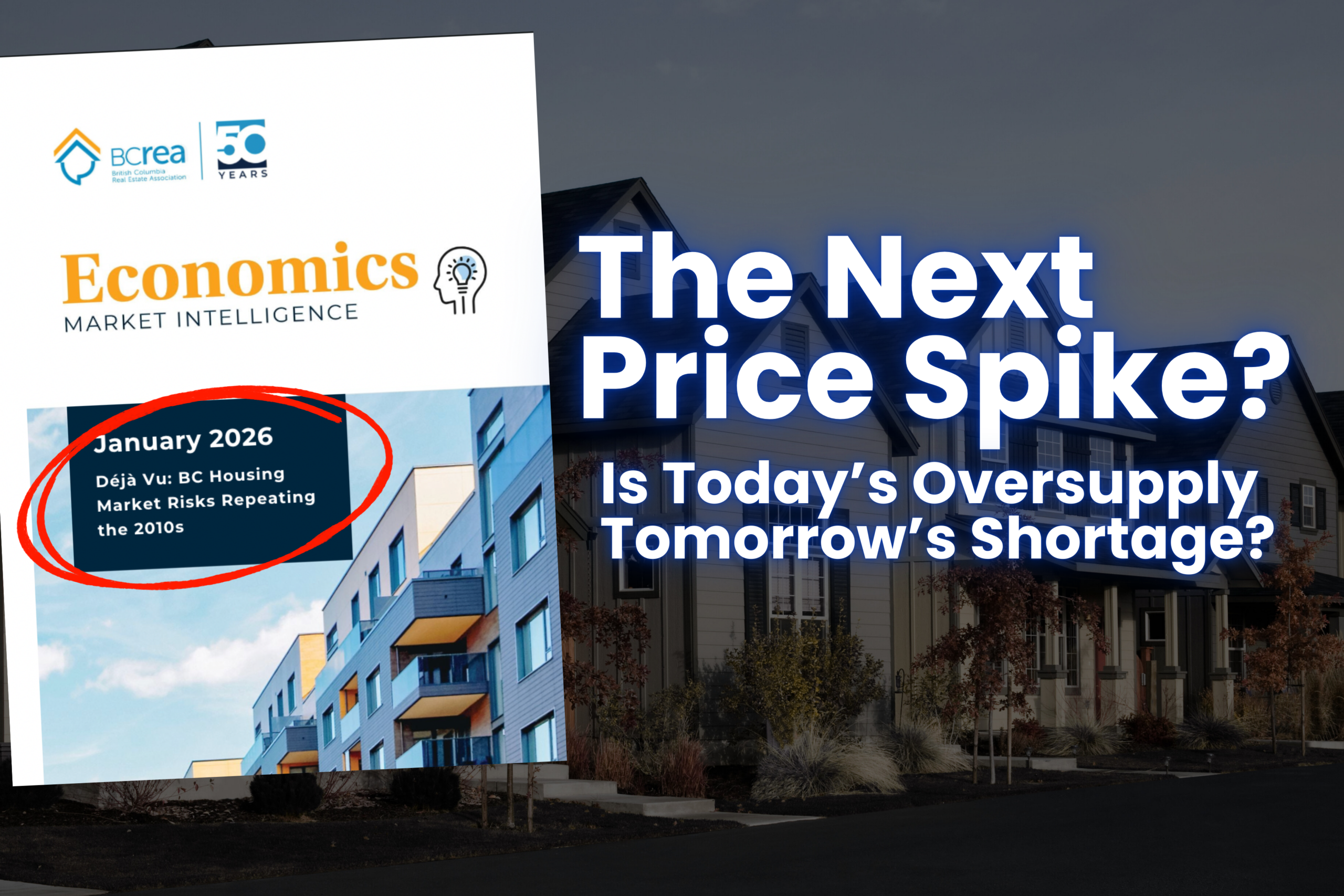
Over the next 12 to 24 months, the completion backlog from the building booms of 2020 and 2021 will continue to trickle onto the MLS. According to CMHC, total housing completions across BC are projected to reach around 43,000 units in 2025, one of the highest levels in recent memory. Many of these are multi-family projects that were presold in the frothy days of cheap money. With thousands of new condos hitting a market already grappling with weaker demand, the short-term effect is straightforward: buyers will have more choice, sellers will face stiffer competition, and pricing power — particularly for entry-level condos and townhomes — will lean in favour of well-qualified buyers. Expect modest downward price pressure for some segments, though not a crash — especially as developers adjust future starts in response to today’s realities.
2. High Market Volatility
Hand-in-hand with more supply is a market sentiment that will remain fragile and reactive. We could very well be heading into an era of whiplash: one month or two of stronger-than-expected job numbers or a surprise rate cut could spark a flurry of multiple offers, only to fade just as quickly when the next piece of global or political uncertainty rattles confidence. We’ve already seen how sensitive buyers and sellers are to each new Bank of Canada press release — or Trump tweet. For everyday buyers, this could mean more false starts: bursts of activity followed by sudden pullbacks. Savvy sellers and buyers will need to watch local absorption rates and months of supply rather than trying to game the national headlines.
What Homeowners & Buyers Should Consider

So, what do you do with all this noise? First, resist the temptation to overthink it. The reality is, trying to outsmart the market perfectly – to sell at the exact peak or buy at the precise bottom – is something even the pros rarely get right. My friends and clients know that I often say things like you shouldn’t try to play the market – do what is best for your family when it works for you. What actually matters is your own timing and life stage. If your family has outgrown your townhouse, if your commute is strangling your evenings, or if your investment property has become more stress than income – those are the real signals that should guide your decision, not the latest headline or rate forecast.
For buyers, understand that today’s slower market conditions can be an advantage if you have your financing sorted and you know what you want. More listings mean more options and more negotiating room. Don’t wait for bidding wars to come back just to feel validated — by then, the best deals are gone. For sellers, pricing realistically and prepping your home properly are more critical than ever. Overpricing in a buyer’s market just guarantees more days on market and more competition from better-priced neighbours.
At the end of the day, homes aren’t just investments — they’re where you sleep, raise your kids, and build a life. Use this quieter moment wisely: do your homework, run your numbers honestly, and make the move that fits your actual needs, not your neighbour’s opinion. Markets always cycle, but smart, well-timed decisions hold up long after the dust settles. ✌️