
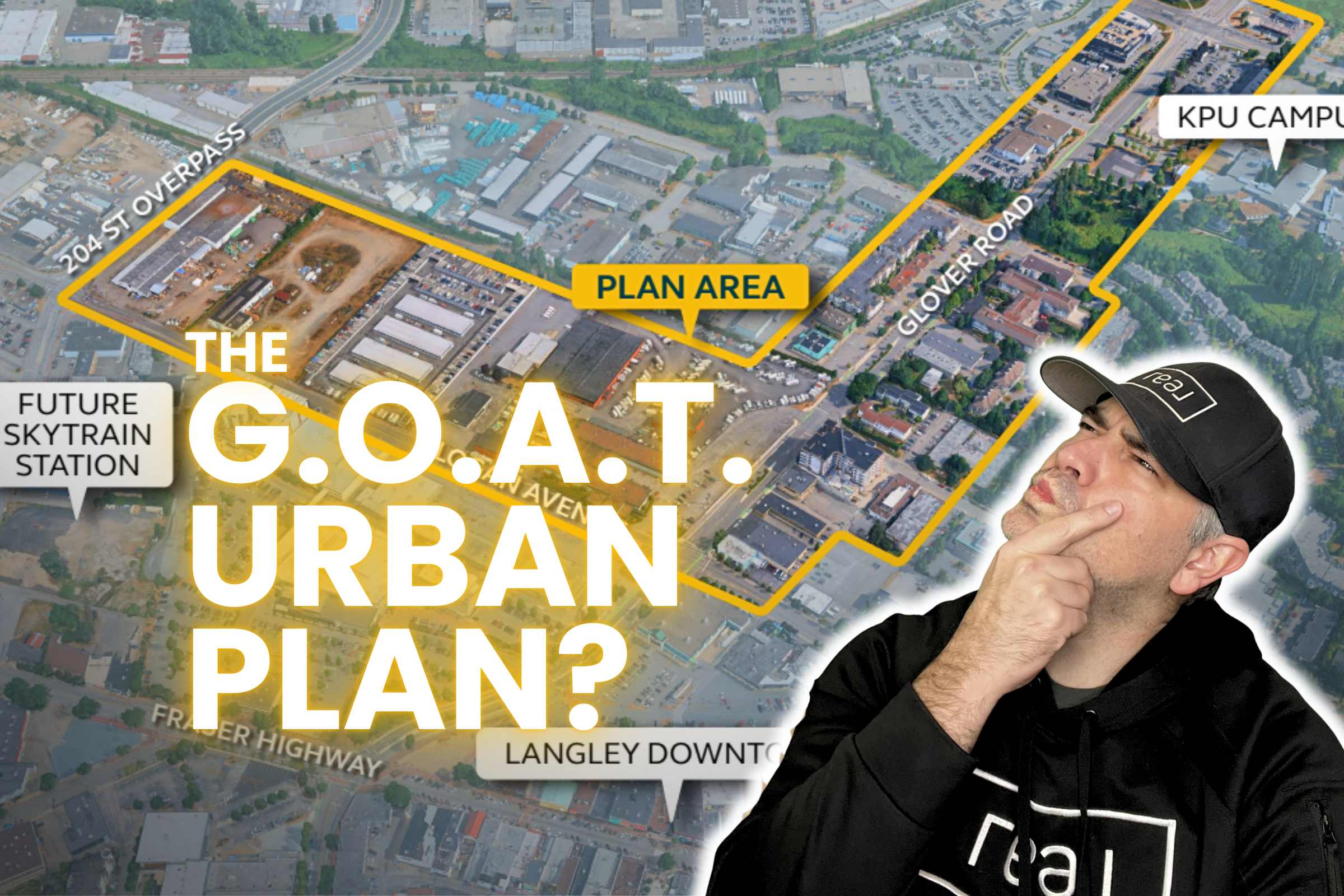
I’ve been known to get pretty excited over pretty nerdy things: city plans are one of those things.
On a quiet, foggy, February night, I dropped the kids off at home from evening school & Taekwondo, drove over to Langley’s local Kwantlen Polytechnic University campus, ignored the paid-parking signage, and check out the information boards on display at a little room.


The public feedback session was as unassuming as you can possibly imagine. I’m use to the Township of Langley – a community that can spend decades on one neighbourhood plan, adopt a plan, throw out that plan, do it again, and during the entire time have hundreds of residents show up to see if they’ve won the real estate lottery. Even purely transit-oriented information sessions brings out a steady stream of concerned citizens.
Not in Langley City.
I walked in at the very end of a 3 hour open house and there were two other couples there and I think I counted 2, maybe 3, “Post-It Notes” on the available 5 feedback boards. I know that there have been other engagement opportunities, but I couldn’t help note the contrast compared to my usual experiences at these sort of open houses.
I’m not suggesting that Langley City citizens are disengaged, although… they do have among the lowest voting turnout rates in the province. Maybe it’s just that, frankly, there isn’t much that gets this community riled up. While Township of Langley politics seem to be in the news all the time, with regular lawsuits to sparring councillors, Langley City appears to be excruciatingly calm – except when it comes to the persistent attempts by the Township to annex their wayward urban sister.
Anyway, this anomaly of a municipality may have just proposed the best district/neighbourhood plan that I’ve ever seen… and I’ve seen a lot.
The planning firm behind Langley City’s “Innovation District” is Arcadis, which describes itself as “the world’s leading company delivering sustainable design, engineering, and consultancy solutions for natural and built assets.” No humility here – but it might be warranted. The international company has some of the best architecture and city plans around the world. The reason I believe this plan stands out so much is that, well, it’s boxed in by two much larger suburban communities and all the suburban-style infrastructure you would expect from a more American-style auto-dependent community: big arterial roads, very limited transit network, primarily detached homes with spattering of sometimes oddly placed condos, plenty of free surface parking, and lots of destination strip malls.

Even the neighbouring Township of Langley struggles to provide for anything other than extensively auto-centric planning, even in its so-called progressive 2050 vision plans for its transportation network or the 200th Street Corridor. Sometimes it feels like as long as planners allow for condos, that’s good enough to call it “urbanism”.
Langley City is forced to take a very different approach. Unlike the Township of Langley or the City of Surrey, the City has very little land and is 98% (or something like that) height-restricted by the federal Aeronautics Act as a consequence of the nearby Langley Regional Airport. Although the current Mayor and Council have been lobbying to ease this restriction, I personally think this restriction does Langley City a lot of good. I think by forcing planners to stay under 15 stories, they end up maximizing its land in better, more innovative ways than just throwing up another skyscraper that often seems out of place in the suburban landscape.
I think this plan is evidence of this.
The Innovation District

The proposed Langley City Innovation District is, by my calculations, under 70 acres, forming an L-shape along Logan Avenue and Glover Roads. The plan provides for a multitude of flexible uses that appears to take the best of all sorts of mixed use worlds:


What isn’t to love with this land use? First you have the focus on the mixed use transit oriented core, which will create an entire new, vibrant heart of the City. Then there are the 15-storey mixed employment corridors that provide the gateways to the plan. This reminds me a lot of Vancouver’s Mount Pleasant Industrial Area which mixes office and industrial space within a walkable community instead of just a bunch of concrete tilt-ups with nothing else around. Then there is perhaps the cornerstone of the plan: the University District. My understanding is that KPU has some serious development partners to build out its ambitious 2050 Campus Plan.
Green & Open Space


Normally I go straight to the transportation plan (yes, even as a REALTOR, I still skip “land use” and want to know how the street grid will work – or not work). However, this time, it was the Open Space map that actually caught my eye. It wasn’t so much the dedicated green space, because there wasn’t a whole lot of dedicated parcels for that, being an urban corridor, but there are some substantial parcels that are labeled “Proposed Plaza Space” and “Proposed Green and Plaza Space”. Notably, there would be a very large plaza that would be literally a block north of the future Langley City Skytrain Station. This is as European-feeling as it gets. What I loved about my trip to Munich this past fall was jumping on and off the Subway/Tram and there would be a fully walkable (no cars) plaza. The energy, even post-Oktoberfest and in the rain, was something you rarely see in North America. We’ll see more about this plaza in particular below, but in the meantime, here are a couple photos from Munich of two places right outside of two very different stations:


Transportation


Based on my urban planning research, especially inspired by Jeff Speck, I’ve learned about how small blocks are essential to walkable, pedestrian oriented neighbourhoods, especially in a downtown core. This fabric creates connectivity that is optimal for short, useful, interesting jaunts. This significantly decreases the reliance on the vehicle and rewards other modes of transportation in dense areas.
I made some relative comparisons between the current state of affairs, which aren’t horrible, to the proposals for Glover Road and Logan Avenue. Remember, these are THE major arterial roads for Langley City. You can see how the plan is take these barren asphalt wastelands and convert them to active streetways. It is important to note there was a bit of a mistake on the Glover Road Corridor sketch: that is a two-way street, not a one-way.


What I really love about this is the multiple treed buffers that protect pedestrians AND cyclists from street traffic (see Walkable City Rule 78). This provides for not just a safer experience, but also a more comfortable one. Add to that that there are multiple floors of commercial at the ground level, which adds to the “interesting” component of walkability (see Walkable City Rules 88 & 90).
Neeedless to say, the combo of the “Landscape Buffer/Plaza” and “Bi-Directional Bikelanes” only add to the European-flair of this downtown plan.
Precinct 1: The Gateway


The Plan is divided into three “precincts”, each with its own focus. I honestly don’t know if I have a personal favourite – they all have something that make a great livable urban environment. Precinct 1 was the area that caught my attention first because of the half-acre Logan Plaza. Okay, that’s not a name yet, but I’m coining it. This precinct maybe the most important that they get it right because it is the gateway to and from the Skytrain. This is where a lot of people are going to leave the station, walk out and be greeted with this new district. It is absolutely genius to have a plaza here.
“Precinct 1 is planned to be a strong employment node, supporting intensified light industrial, commercial and office use. Target industries are the cultivation and handling of food and beverage, entrepreneurship, creative arts and industries, research, sustainability, and compact and advanced manufacturing.”
I’m not going to lie, having a big Casino & Convention parkade right outside the station as well is a bit of an eyesore, but this plaza is going to draw the focus away from that and steer people towards the “new downtown”.
Precinct 2: The Community


This is, as I said earlier, the “heart” of the downtown. The intention is to steer redevelopment to “smaller ground-oriented units” that benefit small-medium sized local businesses.
Precinct 2 will aim to establish a complete community, with diverse housing options, retail space focused on active frontages, and various commercial unit sizes to suit a range of business needs. This will promote people living and working within the Innovation District – encouraging short commutes, and supporting new businesses with a
customer base.
I’m looking forward to the future details of this plan because I would like to know how many housing units they plan for this area. Either way, it already looks to have the urban village flow that suburban cities like Surrey, Langley Township, and Abbotsford have struggled to re-create at any scale. Langley City’s compact nature already gives it a head start for this possible revitalization.
“A corner plaza at Glover Road and Logan Avenue will create an inviting entrance from downtown, connected via a pedestrian greenway with activated retail frontages. The Internal Street is planned to link to Eastleigh Crescent, establishing a new neighbourhood block.”
Again, this abundance of large walkways and plazas is very reminiscent of European-style downtowns that have an abundance of mixed use mid-rises and a focus on the street level activity.
Precinct 3A: The Entrance

Precinct 3 is actually divided in two: the vehicle-based entrance and the university district. In fact, the plan even states that 3A “serves as an entrance for vehicles to the city.”


Since this is the cross section of two arterial roads, including the very busy Langley Bypass, the challenge with this area will be the transition from the outside “auto world” to the much more walkable Innovative District. For it to be successful, it will need to feel organic, still allowing for vehicles to passthrough, while also making it comfortable for urban street life.
“Precinct 3a is envisaged for high-employment uses that could benefit from strong transit access and direct highway connections for trucks and convenient pick-up/drop-off. Intensive light industrial uses including assembly, manufacturing and production will be supported.”
Precinct 3B: The Education


I have always loved university districts – when they do the job of university districts. Interestingly, it was my experience of moving from a commuter college like Kwantlen University College (as it was named at the time) in my first year to the University of Alberta that I really appreciated the difference of what it’s like to have a student-based community that was, unlike UBC, very integrated with life outside of the district. This plan creates an opportunity for this on-and-off campus mixture.


As the graphics from the KPU 2050 Campus Plan above show, the campus is already well situated to become an integral area to the overall district and Langley City community. However, until now, as a strictly commuter college, activity is limited to students driving or taking transit in, then leaving. However, KPU is proposing at least two 8-storey student housing building (“C” and “F” on the diagrams) which will add to the vibrancy of the community. I don’t know how many students this will house, but considering dorms are generally substantially smaller than long-term living spaces, we could see something like 500 beds on campus.
This could add to the on-off campus synergy with the street scene, the Skytrain usage. The approximate 15-minute walk from KPU to the future Langley City Skytrain station will take students, instructors, community groups, and KPU-Brew Lab fans almost the entirety of the Innovative District. I think this is simply awesome because some of my most memorable times while attending the University of Alberta was walking from campus to various spots on Whyte Avenue and other non-University locations.

Concluding Remarks
Of course, this is just a plan. Plans needs to be executed. This takes time, money, and political will. I wouldn’t doubt that a lot of this is unlikely to be achieved even in my lifetime. Yet still, a great plan allows for a great future. Too many of our suburban plans are lacklustre halfway measures that try to please both the current residents and developers. Yet so many those plans end up failing future residents with their short-sighted planning.
I think our plans need to look past even 25 years. For those of you in Langley, look at the 1998 Willoughby OCP and the problematic multi-generational issues it has caused by not looking forward enough. The problem with 20 or 25-year plans is that it allows the people who won’t even be here anymore drive the train. That’s the struggle with greenfield development. However, what Langley City has done is taken its urban landscape and given a forward-thinking focus that will guide development as it comes into a place that people will actually want to live, work and play.
My sincere hope is that both Langley Township and the City of Surrey and take lessons from this response to the incoming Skytrain station and give their transit-oriented planning a bit more thought – not just “here is smattering of towers in suburban sprawl”. I also hope that the Province of BC also reconsiders Bill 47 and provide more flexibility for planning that doesn’t involve towers and instead allow for more European-style mid-rise urban village density.

Leave a Reply