Why Costs, Scale, and Technology Are Forcing a Real Estate Revolution
While I was studying for my real estate exam back in 2010, I researched every brokerage with an office operating in my hometown of Langley, BC, Canada. I interviewed almost every local managing broker. Not only that, I spoke with agents in those offices. One thing I knew, based on all my research, is that I am an independent contractor and I’m interviewing THEM. Unlike a typical job, I’m asking what I’m paying THEM for, not the other way around. However, as like any new agent, I didn’t have an in-depth understanding about brokerage models or where technology was heading as it related to the business. I did know that I wanted to be different, not just in words, but in action and I wanted a company that supported this.
I narrowed my original choices down to two: let’s call them “Brokerage A” and “Brokerage B”. Both were Canadian-based firms that seemed to really represent my commitment to ethics and professionalism. They didn’t scream “money first”. “Brokerage A” had no monthly fees, but did have a high 70/30 split up to around $65,000, then incrementally better splits up to around 90/10 until around $100,000 – but no cap. It also had an amazing, very experienced “Dale Carnegie”-type managing broker who had been one of the instructors during my licensing. In fact, a lot of that company’s managers were instructors in my licensing and that indicated to me that the firm valued education. Their Langley office was a fair bit out on the outskirts of town and a bit dated, but had a “homey” family-friendly feel to it. The logo and branding also felt a bit dated to me, but they had that “boutique” presence. Although the other offices in that firm were owned by one company, this particular office was a franchise offshoot – but it was known that when the owner/broker retired, it would be bought out by corporate.
Brokerage “B”, on the other hand, had no split, but had a moderate monthly fee (ie $400-500), a relatively high transaction fee ($350-500) and a low royalty (1-2%). I’m giving ranges in brackets because I don’t remember the exact figures, and they did change over time. The manager was a bit goofy, but he had an intense friendliness to him. The office was much more “business-oriented” and was in the heart of town. It was a franchise with large national firm. As with most real estate brands of the day, I wasn’t really drawn to the corporate identity. It too felt dated, like a product of the 1990s, but they also gave a lot of freedom to their agents to make their own brand, so long as they followed the regulator’s rules and their own brand compliance.
I ended up selecting “Brokerage A”. I told most people that it was because I just couldn’t say no to the manager – he was just someone that I immediately looked up to for so many reasons – many of which I would discover later in my career. Although this was a significant factor, perhaps the true reason was that I was completely broke, paying rent and soon a mortgage, was planning on quitting my $20 per hour job to do full time real estate and had very little savings. I did my own math and figured I couldn’t survive long with the monthly fees in a real estate market that was extremely pitiful. I would rather pay the high split when I had a deal than to pay a monthly fee when I wasn’t making any money. That’s just being honest. It’s also a decision making factor that many agents end up making.
The problem with this model for so many brokerages is obvious once you’ve been in the business long enough to actually make money. They only make money when their agents make money, but when they do make money, too many agents do exactly what I did: I left for another firm that was better for my personal economics. It’s a similar challenge that most team leaders face.
After 5 years in the business I left “Brokerage A” for “Brokerage C”. “Brokerage C” were the “Big Dogs” (their label, not mine). It was THE place to be though. They had more top agents than anyone else. This wasn’t really due to anything special they offered – it just made economic sense. They had very high monthly fees ($1400-1600), no split, no transaction fees, a small annual fee and a limited royalty (1% up to $200k). I figured out that by the time I did 15 transactions, I was paying WAY more for being at the small regional firm with very little market share than the big name brokerage with the most market share. I couldn’t say I was being offered anything more by being at “Brokerage C”, but considering I was now way past 15 transactions, it no longer made any financial sense being at my original firm. Of course, I would have to keep producing to make it make sense, but that’s why I’m in the business, right?
I proceeded to grow a team and we leapfrogged into the top 1% in the region. The timing had been perfect. But I wasn’t satisfied. Now I knew I could do this – but I wanted more. I knew I wasn’t really “team leader” material. I knew I was a better mentor/coach type than a team lead. I won’t get into the psychology of the successful real estate team leader here, but I knew I wasn’t it. However, I knew I could be a great broker/owner. So I went on the prowl. I made soft offers to local franchise owners. I even flew down to California a bunch of times and offered to buy one of their struggling offices. It was during this time, throughout 2017, however that I first saw the weaknesses in the current brokerage model. I was use to my firm being the “be all end all” of the industry because I had a limited regional view. I didn’t realize how much things were changing on the continent, and why, until then. What I saw during my Californian adventures was a much more fractured and fragmented industry. I saw the growth of consumer-based technology solutions and less reliance on traditional name brand recognition. This was a warning call to me. The company I was with, which was currently #1 in market share in my region, didn’t even break the top 10 in Southern California. The more I researched, the more I understood why and why California’s present reality would eventually come to Canada.
Awakened to some of these realities, I would eventually become frustrated with the lack of technology offerings and their economic fundamentals. When markets turned or their agents had downturns, they would lose them. The growing costs of being a real estate agent while also facing an over-saturation of competition (both in new agents and new business models) was weakening the value added proposition of traditional brokerage models. The problem was that it too often relied primarily on it’s established name recognition and dated economics to attract top producers in sellers markets. In a time when Netflix and AirBnb was usurping massive brands, I was growing very wary of putting my money into a brand that didn’t seem to be understanding the future and appeared to be too big to change. I decided to open up my pursuits outside of my current franchise.
I knew I didn’t want to be an individual agent and I didn’t want to be a team leader. I jumped from brokerage to brokerage in a short period of time, researching their offerings. I was even told by own major international franchise that I had one of the best franchise business plans they’d ever seen. Yet I couldn’t make the economics of owning a brokerage make sense to me. I didn’t want to turn into a full-time recruiter with a constant turnover of agents. Yet this was the reality of being a broker-owner without a strong value added proposition that could compete with some of the nationally-owned based companies (Zillow, Redfin, Compass, etc) I was seeing in the USA that would eventually come to Canada. I was torn between my dream to own a brokerage and the financial realities of where the industry was and where it was heading.
At the same time that I was struggling with my role in the industry. Over the years of around 2018-2023, I felt I was in the middle of a transformational shift in the real estate industry. While I also criticized the negative aspects of it, I saw the positives as well. The reality that I saw was that there were economic and technological forces at place during this time that were forcing our industry to evolve, whether or not the established status quo admitted it. It wasn’t like this was the first time that the real estate industry went through a major upheaval.
The previous real estate revolution (1970-1983)
In the post-war decades, many Canadian and American firms operated under a model that now feels very distant. Brokerages were more centralized, administrative oversight was heavier, and compensation structures resembled employment more than entrepreneurship. The model worked because the economics worked. Office space was much more affordable, staffing costs were manageable, and transaction volume comfortably supported the overhead. Agents were gift-wrapped a lot of business by their brokerage, which had the money to conduct big ad campaigns and offices on main streets.
That era is not abstract to me. My grandfather, Henry Block of Block Bros. Realty, built a highly successful national Canadian brokerage throughout the 1950s, 60s, and 70s under that structure. Don’t quote me on this, but I believe Block Bros Realty, at it’s peak, was the second largest firm in western Canada. It was a productive, stable, and culturally cohesive operation. I don’t know many agents today that were working in my region during before the turn of the century that don’t know that company’s impact on our industry. Some experienced agents have showed me advertisements that promoted relocation efforts whereby the brokerage would pay for hotels and other incentives if you used their services. Nowadays, such expenses undertaken by a brokerage is unheard of. Like most effective systems, it remained viable until the underlying generational economics shifted.
The last modern reset arrived in the late 1970s and early 1980s. Independent contractor models and so-called “100% commission” upstart brokerages such as RE/MAX did more than adjust splits. They reorganized the relationship between agent and brokerage around autonomy and incentives. The firms that emerged strongest were not those with the most tradition, but those whose structures aligned with the new economic reality. Agents in this new era would front the risk, but they would also take home the reward. Successful agents would scale teams that took over the role previously filled by brokerages.
I believe this pattern is repeating. This time, the brokerage revolution is not primarily about compensation splits. It is about fixed costs, scale, and leverage in a new economic and technological era.
The growing pressure of fixed costs
The most significant pressure facing traditional brokerages today is not branding, recruiting, or commission structure. It is fixed cost, and the inability of fixed cost to contract when the market slows and/or agents aren’t willing to pay for space when they have the tools to do business from home.
Start with office space. Two to three thousand square feet is enough to support a bullpen, several offices, a boardroom, storage, and reception. Yet in many markets, even this modest footprint creates a six-figure annual obligation before staffing, furnishing, or technology enter the picture.
In Metro Vancouver, Cushman & Wakefield’s Q3 2025 office market data places average gross asking rents at approximately $53.52 per square foot. At that rate, a 2,500 square foot office costs roughly $134,000 per year in rent alone. Downtown core figures in the same report rise further, with average asking rents closer to $60 per square foot and Class A or AAA space approaching the high-$60 range. At those levels, annual rent easily reaches $150,000 to $170,000.
This is not just an urban problem. Suburban markets frequently described as “lower cost” still demand costs that would have been considered extreme in prior decades. Even a Class A benchmark around $35 per square foot, commonly cited for Surrey City Centre, results in an annual rent obligation near $87,500 for the same footprint – and that’s just the basic rent.
The pattern holds elsewhere throughout the continent. In Austin, TX published market data shows average full-service office rents in the high-$40s per square foot, placing a comparable office near $120,000 per year. Even in nearby lower-cost nodes, quoted averages around the low-$20 range still translate into more than $55,000 annually, before staffing, systems, and compliance costs are added.
Rent, however, is only half the fixed-cost equation. A physical office requires people to operate it. Front-of-house coverage, transaction coordination, file compliance, accounting, agent onboarding, and daily troubleshooting do not disappear when transaction volume declines. Even conservative staffing models quickly create a second six-figure obligation once benefits and payroll burden are included.
In practical terms, it is not difficult for a traditional brokerage to carry $200,000 to $300,000 per year in combined rent and staffing before a single dollar is spent on marketing, training, insurance, technology, or professional services. These costs do not scale down cleanly. Too many of these costs remain due regardless of how many deals close. That reality shapes every strategic decision a brokerage makes.
A market that stopped cooperating
This cost structure has come under strain for two reasons: transaction volume no longer reliably supports it and agents are no longer seeing office space as having the same value as they did previously.
In the United States, existing-home sales fell sharply after the pandemic surge. By 2023, annual sales dropped to roughly 4.09 million units, representing one of the weakest years in decades. Activity remained historically depressed into 2024, reinforcing that the slowdown was structural rather than temporary.
Canada experienced a similar contraction. National sales volumes fell to levels not seen since the global financial crisis, with CREA reporting just over 443,000 transactions in 2023, an 11 percent decline from the prior year.
Lower volume is not merely a revenue issue. It is a margin issue. When transactions decline while fixed costs persist, brokerage economics stop being neutral. They become selective. Some models absorb the pressure without altering service. Others face unavoidable trade-offs: higher fees, reduced support, deferred technology investment, and increasing reliance on recruiting simply to keep overhead covered.
I have spoken to so many franchise broker-owners in my market where they are regularly not only not taking any income from their brokerage, but they are actually feeding it with their own sales income. This isn’t financially sustainable.
Why platform brokerages keep growing
This is where the divergence becomes difficult to ignore. Cloud-native, platform-driven brokerages have expanded during the same period that many traditional firms have faced margin compression. eXp was the first mover at scale. As of late 2025, the company reported more than 83,000 agents globally and continued to add productive volume without inheriting the same physical overhead profile as office-centric organizations. What matters is not eXp’s size alone. It is the fact that a brokerage can reach that scale without carrying a corresponding portfolio of leases and localized staffing structures.

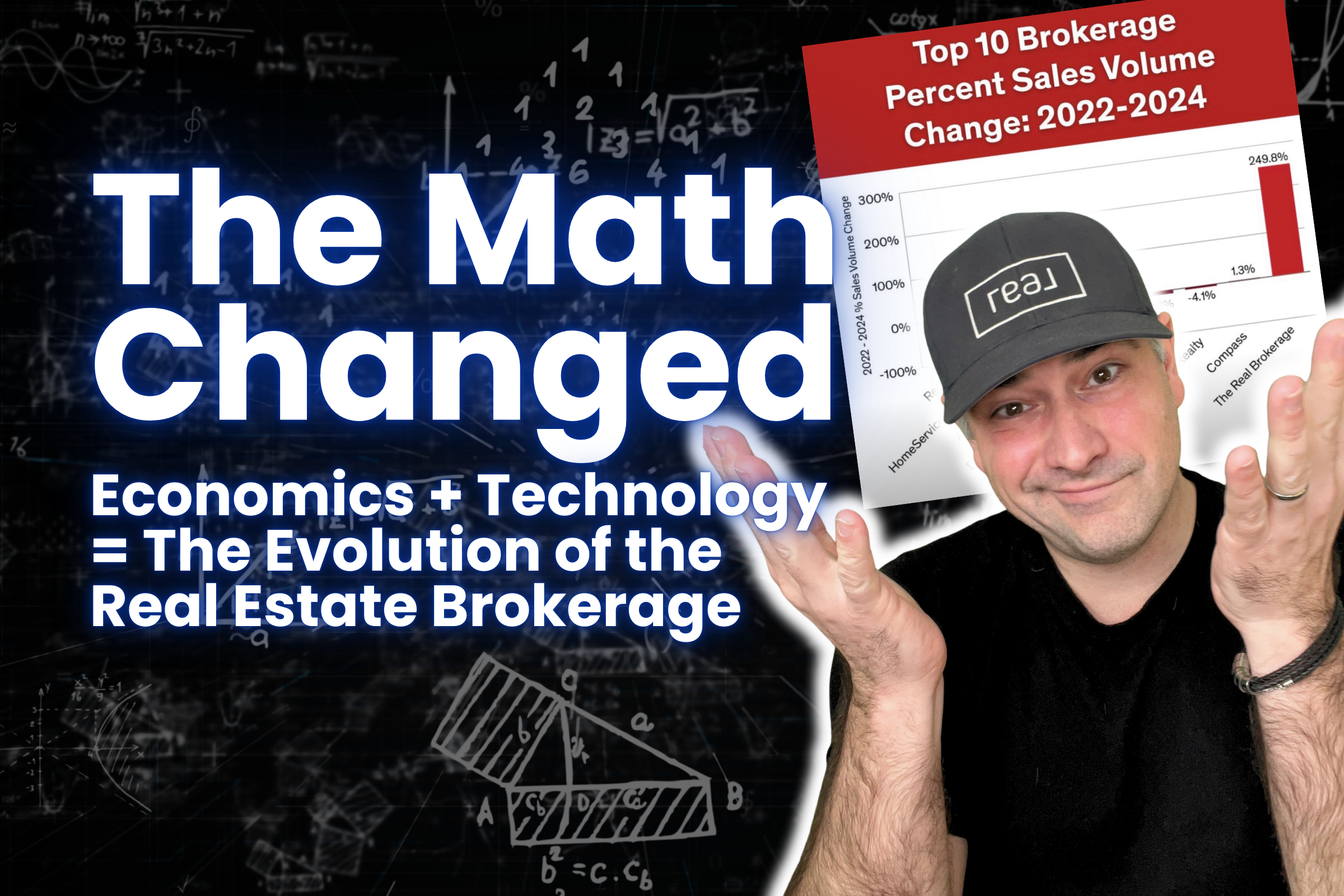
The Real Brokerage illustrates the next stage of this evolution. It follows a similar cloud foundation, but places greater emphasis on proprietary platform experience and centralized operational support. When I joined in March 2024, Real was just crossing 16,000 agents. By late 2025, that number exceeded 31,000. The brokerage effectively doubled its agent base in a short span, during a period when overall industry agent counts flattened or declined. Neither eXp Realty or The Real Brokerage were noted to pass down their savings to be “cheaper” solutions – instead, they opted to put those savings into revenue sharing and technological advantages to their agents.
LPT Realty represents a further refinement. By positioning itself with offering a lower-cost solution and making the fixed-cost advantage visible in its agent value proposition, LPT achieved national scale in roughly three years, surpassing 15,000 agents by 2025. Industry reporting suggests that this growth translated into tens of thousands of transaction sides and billions in annual sales volume.

T3 Sixty recently highlighted how national real estate brokerages, as opposed to franchise models, are leveraging technology and services platforms to grow.
The pattern across these firms points to the same underlying mechanism. When a brokerage reduces its fixed-cost load and centralizes support through software-assisted operations, the cost per agent declines as scale increases. Capital that would otherwise be locked into leases and payroll can be redirected into pricing flexibility, platform development, and growth incentives. In low-volume environments, that difference becomes decisive. The math does the work.
Brokerages are, at their core, recruiting businesses
Cloud models also surfaced a reality the industry often avoids stating plainly: brokerages do not generate meaningful profit unless someone is recruiting agents. You can call it recruitment or attraction, but someone is doing it. This is not a moral judgment, it is the structure of brokerage revenue. Company dollar spreads thinly across a base of agents while fixed obligations remain. Every brokerage therefore has a minimum scale threshold to reach sustainability, and a higher threshold before ownership becomes economically compelling.
In my own experience reviewing and accepting franchise agreements, breakeven typically occurred around 45 to 60 agents, assuming I acted as the managing broker. Hiring a separate managing broker became viable closer to 80 to 100 agents. Replacing my own sales income with brokerage income alone required something closer to 150 agents if I wanted to provide agents with as much value as possible.
Those figures vary by market and model, but the directional truth remains consistent. In many traditional structures, perpetual recruiting is not optional growth. It is what keeps the model viable. That requirement carries consequences. Time spent recruiting is time not spent on compliance oversight, agent development, risk management, or long-term planning. As agent counts rise, the system becomes increasingly dependent on a small group of people to continually feed it.
Revenue-sharing cloud brokerages exposed an alternative. Rather than concentrating recruiting responsibility in a broker-owner or internal team, they distributed recruiting incentives across the agent base. Agents became the growth engine. If we are honest, this approach carries its own challenges. It can produce unwanted peer-to-peer solicitation, uneven onboarding, fragmented culture, and variability in mentorship without deliberate investment in standards and training. Economically, however, it removes the recruiting bottleneck. Growth no longer depends on a single role or department. It scales. The brokerages that overcome the hurdles in this model are the ones that are going to find exponential success.
Why national platforms behave like technology companies
Many national cloud brokerages adopted a technology-company playbook. They raised outside capital, accepted periods of unprofitability, and built infrastructure at scale before fully optimizing for margin.
Most local brokerages cannot pursue that path. Independent broker-owners remain conservative by necessity. Their ability to invest is constrained by cash flow and personal risk. Franchisors generate meaningful revenue, but most are not structured as research-and-development organizations focused on building proprietary platforms.
As a result, much of the industry relies on third-party vendors for core workflows such as transaction management, CRMs, and marketing automation. That reliance creates strategic exposure and dependence on solutions that may be working against them. When those tools sit inside vertically integrated ecosystems, control over data, incentives, and long-term dependency shifts away from the brokerage (Zillow owns Showingtime, Follow Up Boss, dotloop, etc).
National platforms can justify internal development because scale makes it economical. Traditional brokerages often cannot. Over time, the gap widens. With the dawn of generative A.I. and the associated research and development, those who have invested heavily in their own internal systems are simply going to come out ahead. If brokerage firms continue to focus primarily on selling franchises rather than development agent and consumer-based technologies, they aren’t going to survive the next evolution.
Where the pressure leads
There will always be room for boutique brokerages serving niche markets where proximity, specialization, and high-touch service justify higher overhead. At scale, however, rent-heavy and staff-intensive models face a structural disadvantage that becomes most visible when transactions slow and when they fall behind on expensive technological offerings.
Brokerages that deliver comparable or superior outcomes with materially lower fixed expenses will continue to attract agents in margin-constrained markets. Others will feel increasing pressure to charge more, offer less, or recruit faster simply to maintain position.
The brokerage industry is not collapsing. It is reorganizing, much as it did half a century ago. As before, the models that endure will be those most closely aligned with the math of their time.